
AI saves the average estate agent 2.1 hours a week, according to Alto’s 2027 AI in Estate Agency Report. That’s around 97 hours a year, or two and a half working weeks per person. But the average hides a huge spread: 41% of agents get back an hour or less, while the most advanced fifth are saving five hours a week and taking home nearly half of all the time AI saves across the industry.
If you’ve asked yourself whether AI is worth the bother, this is the number you were after. Here’s what sits behind it, why most agents are stuck at the bottom of the range, and what the ones at the top are doing differently.
Download the full AI in Estate Agency 2027 report for free. Take two minutes to assess your agency’s AI maturity and see how you compare to the industry.
The headline number: 2.1 hours a week
Estate agents who use AI save 2.1 hours per person per week on average. That’s from Alto’s survey of more than 250 UK estate and letting agency professionals, carried out between 31st July and 4th August 2026.
Over 46 working weeks it adds up to roughly 97 hours a year. For a ten-person agency that’s most of a full-time post. Worth having. But it’s not what the industry has been promised, and for a lot of agents it’s not even close to 2.1 hours.
Most agents are getting far less than the average
41% of estate agents say AI saves them an hour a week or less. That includes 13% who say it saves them no time at all.
Here’s the full distribution:
| Time AI saves per week | Share of agents |
|---|---|
| None | 13% |
| Under 1 hour | 28% |
| 1 to 3 hours | 31% |
| 4 to 7 hours | 10% |
| 8 hours or more | 6% |
| Don’t know | 12% |
Source: Alto, The 2027 AI in Estate Agency Report.
Only 16% get four hours or more back. The 12% who don’t know are a finding in themselves. If you can’t say whether a tool saves you time, you can’t make a case for using it more, or for stopping.
Why the spread is so wide: it’s about what AI is pointed at
The time an agent saves depends far more on where they use AI than on which tool they use. Most agents use it for a handful of writing jobs: property descriptions, emails, admin, social posts. There are only so many minutes to be had from polishing an email, and the data shows it.
| How AI is used | Average hours saved per week |
|---|---|
| Not using AI | 0.2 |
| Writing and admin tasks only | 1.3 |
| Writing tasks plus one operational area | 2.3 |
| Two or more operational areas | 3.8 |
Source: Alto, The 2027 AI in Estate Agency Report.
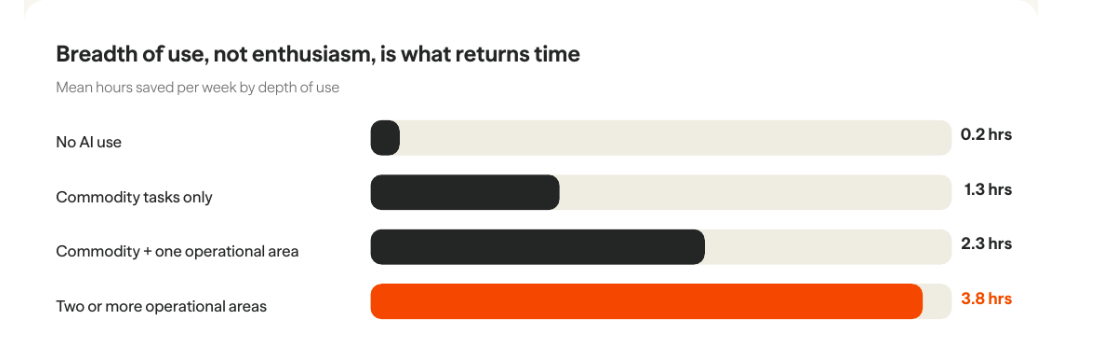
Bar chart of average hours saved per week by estate agents by depth of AI use: no AI 0.2 hours, writing tasks only 1.3, one operational area 2.3, two or more operational areas 3.8. Source: Alto 2027 AI in Estate Agency Report.
Agents who use AI only for writing save 1.3 hours a week. Agents who use it in two or more operational areas, such as reporting, prospecting, lead handling, progression or compliance, save 3.8 hours. Nearly three times as much, and the return rises at every step in between.
That’s the whole story in one table. The tool isn’t the difference. The number of jobs it’s been given is.
Lettings agents are saving three times more than sales negotiators
Lettings and property managers save 2.5 hours a week through AI. Sales negotiators save 0.9. The gap follows the same pattern: lettings staff use AI across 2.84 areas on average against 1.95 for sales, and they’ve pushed it into admin (48%), reporting (32%) and compliance (12%), where the sales negotiators surveyed use it for none of those.
Part of the reason is pressure. Research from Propoly found three quarters of lettings professionals say the Renters’ Rights Act has increased their admin workload, with a quarter calling the increase significant, so there’s an obvious incentive to hand some of it over. Whatever the cause, the pattern holds across the whole survey: the more of the job AI takes on, the more time comes back.
The top fifth are saving five hours a week
The most advanced 20% of agencies save five hours per person per week, and account for 48% of all the time AI saves across the survey. The least engaged 40% account for just 10%.
Alto scored every respondent on an AI maturity index combining five things: their declared AI status, how many areas they use it in, how many of those are operational, the time it saves, and whether anyone in the agency owns it.
| Maturity band | Share of agents | Hours saved per week |
|---|---|---|
| Absent | 15% | 0.2 |
| Exploring | 30% | 0.6 |
| Embedded | 37% | 2.3 |
| Advanced | 18% | 5.0 |
Source: Alto, The 2027 AI in Estate Agency Report.
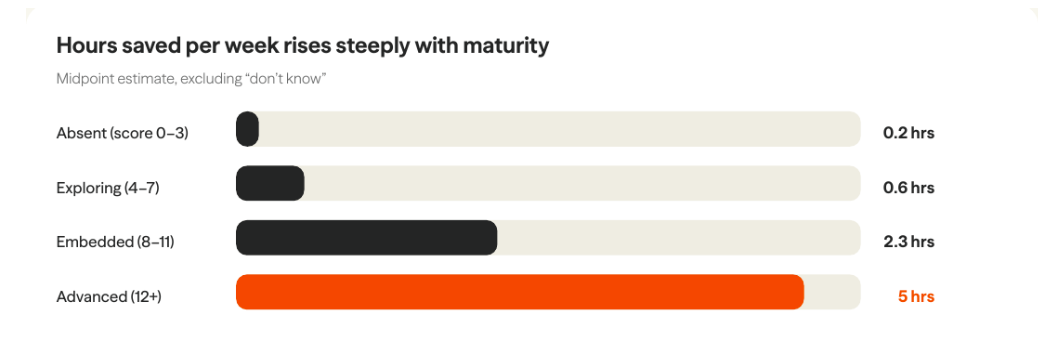
Bar chart showing hours saved per week by AI maturity band: Absent 0.2, Exploring 0.6, Embedded 2.3, Advanced 5. Source: Alto 2027 AI in Estate Agency Report.
That’s a 25-fold spread between the bottom band and the top, inside a market where nearly everyone is using the same tools for the same four writing tasks. And the advanced group isn’t defined by size or budget. Half of them run a single branch. What separates them is that 60% describe AI adoption as a leadership decision, against 24% of the bottom half. Somebody decided to use it on purpose and pointed it at more than one job.
What the top end looks like in practice
The survey figures cover every kind of AI use, from a free chatbot in a browser tab to tools built into the agency’s CRM. The bigger numbers come from the second kind, where AI has access to the agency’s own data and can finish a job rather than help with it.
Two examples from Alto customers in the report:
- Hunters Bradford cut listing creation from 3 to 4 hours per property to 25 to 30 minutes. Across roughly 30 listings a month, that’s more than 75 hours back. Robert McCarthy used to spend up to 14 hours every Friday on listings and portal uploads. Now he’s done by midday. Read the Hunters story
- The Accommodation Bureau in Cornwall grew its managed portfolio from 500 to 700 properties without hiring anyone. Alto Smart Listings took listing time from 1 to 2 hours to around 15 minutes, and working out a landlord’s portfolio value went from “half an hour to an hour’s job” to two minutes with Alto IQ. Read The Accommodation Bureau story
It’s why Alto’s own figure across its user base is 10+ hours saved per user per week. That’s a different measure from the survey (Alto customers using tools built into their CRM, rather than the whole market using whatever’s to hand), but it shows where the ceiling sits once AI is doing operational work on the agency’s real records.
How to get more than an hour a week back
If you’re in the 41%, the route up isn’t a new subscription. It’s the same three steps the advanced group took, in this order:
- Give AI a second job. Moving from writing-only to one operational area nearly doubles the time saved (1.3 to 2.3 hours). Pick the one that eats your week: progression chasing, lead response, compliance renewals, reporting.
- Put a name against it. The strongest predictor of time saved in the whole survey is whether someone owns AI in the agency. Bottom-up experimenting gets you to an hour a week. A decision gets you to five.
- Measure it. 12% of agents can’t say what AI saves them. Track one number for one month, and you’ll know whether to expand or stop.
Alto Intelligence is built for step one: its skills take on whole jobs (appraisals, listings, progression chasing, applicant matching, client messages, business questions) using the data already in Alto, and hand the finished work back for approval. If you want to know which band your agency sits in, test your AI maturity in seven questions.
Get the full picture
This is one finding from Alto’s 2027 AI in Estate Agency Report. The full report covers where agents use AI today, why adoption drops off beyond writing tasks, what agents want AI to do in 2027, and how the sector feels about it. Start with AI in estate agency 2027: what agents actually do with it, or go straight to the report.
Download The 2027 AI in Estate Agency Report.
Not sure where you stand? Test your agency’s AI maturity in seven questions, and see what Alto Intelligence can take off your plate.
Frequently asked questions
How much time does AI save estate agents per week?
AI saves the average estate agent 2.1 hours a week, according to Alto’s 2027 AI in Estate Agency Report. 41% save an hour or less, 31% save one to three hours, and 16% save four hours or more.
How much time does AI save estate agents per year?
Around 97 hours a year per person, based on 2.1 hours a week over 46 working weeks. That’s roughly two and a half working weeks.
Which estate agents save the most time with AI?
Agents who use AI in two or more operational areas, such as prospecting, lead handling, progression, reporting or compliance, save 3.8 hours a week, against 1.3 hours for those using it only for writing tasks. The most advanced fifth of agencies save five hours a week.
Do letting agents or sales negotiators save more time with AI?
Letting agents. Lettings and property managers save 2.5 hours a week through AI, compared with 0.9 hours for sales negotiators, because they use it across more of the job, including admin, reporting and compliance.
Why does AI save some estate agents no time at all?
13% of agents say AI saves them no time, and most of them use it only for writing tasks like emails and property descriptions. Time saved rises with the number of operational jobs AI is given, not with the tool itself.
How can an estate agent save more time with AI?
Point AI at one operational job beyond writing, put someone in the agency in charge of it, and measure the result for a month. In Alto’s research, agencies where AI adoption was a leadership decision saved far more time than those where staff experimented on their own.