

Nearly seven in ten estate agents now use AI regularly. Almost none of them use it where the money is. Alto surveyed 250 sales and lettings professionals from UK agencies this summer, and the results show an industry that has adopted AI without yet deciding what it’s for.
Download the full AI in Estate Agency 2027 report for free. Take two minutes to assess your agency’s AI maturity and see how you compare to the industry.
AI in estate agency means using artificial intelligence tools to do or assist with the daily work of a sales or lettings agency: writing listings and emails, handling admin, responding to leads, prospecting for sellers and landlords, preparing valuations, managing compliance and chasing sales progression. In 2026, most of that use sits in the first two items on that list.
About this research. Alto’s AI in Estate Agency 2027 report is based on an online survey of 250 UK estate and letting agency professionals, run between 31st July and 4th August 2026. Respondents span owners and directors (31%), lettings and property managers (22%), sales negotiators (19%), branch managers (13%) and admin staff (11%), across single-branch (58%), two-to-five branch (32%) and six-plus branch (10%) agencies.
Key findings
- 69% of UK estate agents use AI regularly or daily, but 85% use it in four areas or fewer, almost all of them writing tasks.
- AI saves the average agent 2.1 hours a week. Agents using it in two or more operational areas save 3.8 hours, against 1.3 hours for those using it only for writing.
- The most advanced fifth of agencies take 48% of all the time AI saves, and half of them run a single branch.
- 51% of agents are only vaguely aware, or completely unaware, of the AI already built into the software they use.
- Compliance is the biggest gap: 5% of agents use AI for it today, but 36% name it as a 2027 investment priority.
- Half of agencies expect to spend more on AI in the next 12 months. None expect to spend less.
Source: Alto, AI in Estate Agency 2027.
If you’ve used AI to tidy up a property description this week, you’re in good company. Two thirds of agents have. The question is what happens after that, and for most agencies the answer is: not much.
That matters, because a small group has already worked out what comes next. They’re not bigger than you and they don’t have a budget you don’t have. Ten of the twenty most advanced agencies in this survey run a single branch. They’ve stopped using AI to write and started using it to work, and they’re taking home nearly half of all the time AI saves across the sample.
Everyone is using AI. Almost everyone is using it for the same four things
69% of estate agents use AI regularly or daily, but 85% use it in four areas or fewer. That’s the headline finding from Alto’s AI in Estate Agency 2027 report, and it’s less contradictory than it sounds.
The four areas are property descriptions (67%), emails and general communication (53%), admin (37%) and marketing and social media (35%). On paper that’s four use cases. In practice it’s one: writing. When we asked agents how they personally use AI on a typical day, 43% talked about drafting or rewriting emails, 29% about property descriptions and 16% about polishing grammar or tone.
The verbs tell you everything. Agents told us they use AI to “help phrase a particularly tricky email”, to “spruce up the description”, to “jazz up an email”. This is AI as a proofreader. It improves something the agent was going to do anyway. It doesn’t remove the job.
There’s nothing wrong with that. Descriptions and client emails eat time. But a third of agents who call themselves active AI users do nothing beyond these four tasks, and that’s where the problem starts.
Then the cliff
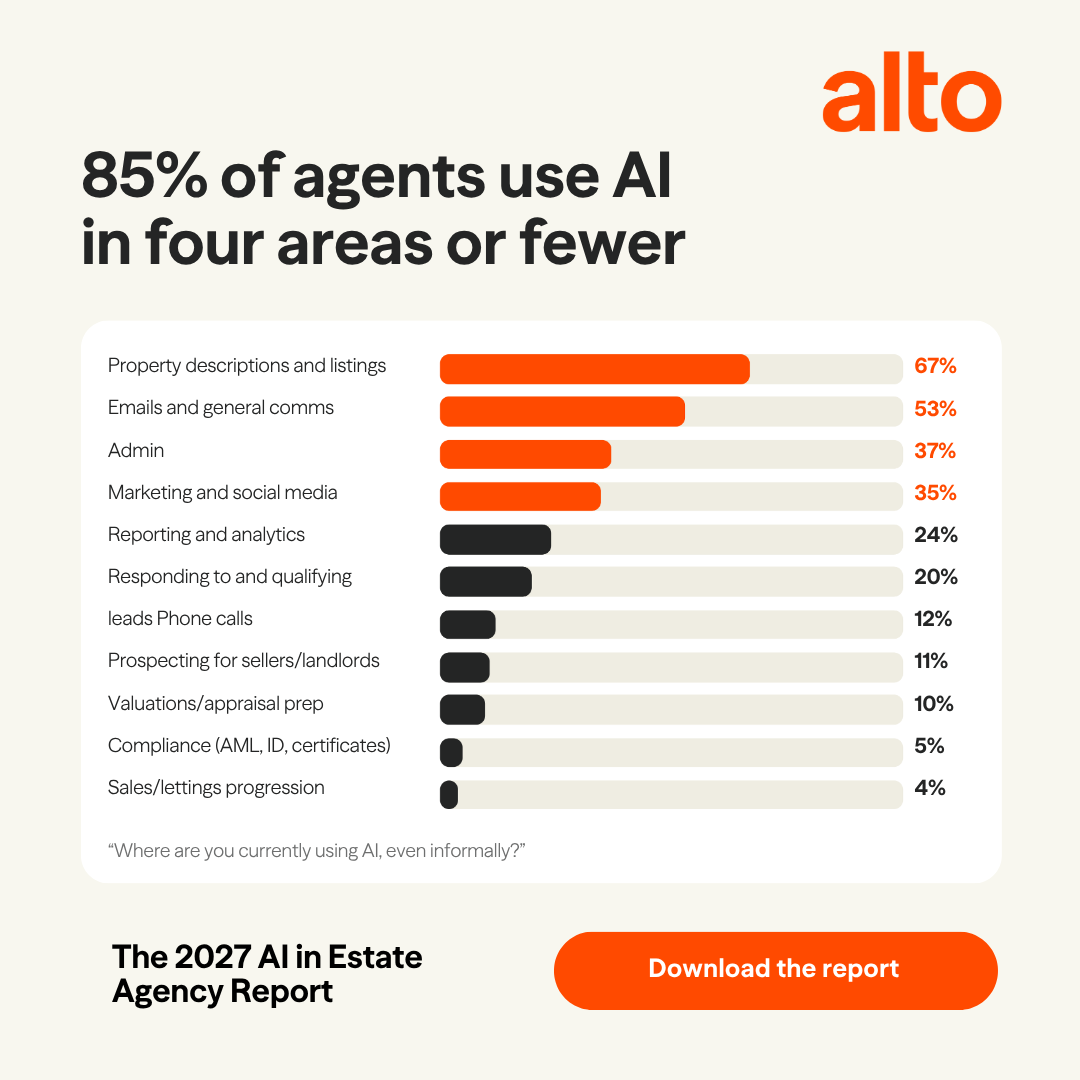
Bar chart showing where UK estate agents use AI in 2026: property descriptions 67%, emails 53%, admin 37%, marketing 35%, then a sharp drop to compliance 5% and progression 4%. Source: Alto AI in Estate Agency 2027 report
Where estate agents use AI today. The four orange bars are writing tasks. Everything below them touches agency systems and data. Source: Alto, AI in Estate Agency 2027.
Beyond writing tasks, AI use in estate agency drops to single figures. Reporting and analytics reaches 24%. Lead qualification, 20%. Phone handling, 13%. Prospecting for sellers and landlords, 11%. Valuation and appraisal prep, 10%. Compliance, 5%. Sales and lettings progression, 4%.
Four respondents use AI for sales progression, the most labour-intensive and margin-relevant process in the industry.
The reason is simple once you see it. The four popular tasks share three properties: they need no integration, no data and no permission. A negotiator can improve a listing in a browser tab without telling anyone. Everything below the cliff is different. To help with progression, AI needs to see the pipeline. To prospect, it needs the database. Compliance needs accurate records and clear processes. Appraisal prep needs the right property and market data. All of that means AI touching the agency’s actual systems and actual client information, which requires a decision, a budget line and somebody accountable.
Adoption stops exactly where organisational effort starts.
The ownership data confirms it. 46% of agents say AI use in their agency is being driven by individual staff acting off their own back. Only 34% describe it as a leadership decision. 14% say nobody is driving it at all. Bottom-up experimentation isn’t a bad thing (it’s free market research on which jobs your team finds painful) but it produces exactly the pattern above: free tools, personal tasks, no measurement, and no memory when the person who liked it leaves.
It also explains the 18% who told us they tried AI and nothing stuck. Of those 20 agencies, only four described a leadership decision. Six said nobody was driving it. Their free-text answers describe the same useful tasks as everyone else. What failed wasn’t the technology. Nothing turned an individual experiment into a business process.
There’s a risk in this too. When staff use standalone AI tools independently, the agency has little visibility over what information is being shared and where it goes, and some of those prompts contain client data. That’s one reason the AI tools UK estate agents are actually using increasingly sit inside the CRM rather than beside it.
What AI is actually worth to an agent right now
On average, AI saves an estate agent 2.1 hours a week. Over 46 working weeks that’s roughly 97 hours a year, or about two and a half working weeks per person. Worth having. Not what the sector was promised.
41% of agents say AI saves them an hour a week or less, including 13% who say it saves them nothing. At the other end, 16% get four hours or more back every week. 12% don’t know, which is a finding in itself: if you can’t say whether a tool saves you time, you can’t build a case for expanding it, or for stopping.
The gap comes down to where AI is pointed. Agents who use it only for the four writing tasks save 1.3 hours a week. Agents who use it in two or more operational areas, such as reporting, prospecting, progression or compliance, save 3.8 hours. Roughly three times as much. There are only so many minutes in polishing an email.
Lettings shows the pattern in miniature. Lettings and property managers use AI across 2.84 areas on average against 1.95 for sales negotiators, and they’re ahead in the jobs that eat the day: 48% use it for admin, 32% for reporting, 12% for compliance (against none of the sales negotiators we surveyed). They save 2.5 hours a week. Sales negotiators save 0.9. With research from Propoly showing three quarters of lettings professionals have more admin since the Renters’ Rights Act came into force, the incentive to hand some of it to the property management software they already run is obvious.
Someone is already pulling away, and you can’t see it
The most advanced fifth of agencies account for 48% of all the time AI saves across the survey. The least engaged 40% account for 10%.
We scored every respondent on an AI maturity index combining five things: how they describe their agency’s AI use, how many areas they use it in, how many of those are operational rather than writing, the time it saves, and whether anyone owns it. The Advanced group saves 5 hours a week. The Exploring group saves 0.6. The Absent group saves 15 minutes.
That’s a twentyfold spread inside a market where everyone uses the same tools for the same four tasks. And because everyone is doing the same four tasks, the gap is invisible from the outside. Your competitor’s shopfront looks like yours. Their listings read like yours. The difference shows up in their diary: who gets to the vendor first, which sales get rescued three weeks before you’d have noticed. You’ll find out when you lose an instruction you thought was yours.
What separates the Advanced group is not what you’d guess. It isn’t size: 10 of the 20 run a single branch, 7 have two to five, 3 have six or more, which is roughly the shape of the sample. It isn’t discipline either. Sales-only, lettings-only and combined agencies all appear in it in normal proportions.
60% of the most advanced agencies describe AI adoption as a leadership decision, against 24% of the bottom half. Half of them believe AI will be essential to running a profitable agency by 2027, against 22% of the sample. Not one of them thinks it’s overhyped.
Ownership is the strongest single differentiator in the dataset, ahead of size, discipline and role. Nobody in this survey is pulling away because they have better AI. A fifth are pulling away because someone decided to use it on purpose, wrote it into more than one process, and can tell you what it saves. A competitor can subscribe to the same software this afternoon. They can’t subscribe to having decided.
Half the sector doesn’t know what it’s already paying for
51% of agents are only vaguely aware, or completely unaware, of the AI features already built into the software they use every day. Only 22% said they were aware and using some of it. And just 6% credit their software provider with driving any of their AI use.
For anyone running an agency this is probably the most useful number in the report, because it means the cheapest available progress requires no purchase at all. Most agencies in this sample pay monthly for an estate agent CRM that now includes AI as standard (we’ve compared five AI CRMs for estate agents on exactly this), and almost none attribute their AI use to it. Either the features aren’t landing, or nobody has told them, or both.
It connects to the ownership problem too. If 46% of AI use is staff experimenting in a browser tab, nobody is looking at what’s already inside the system the agency runs on. Closing that gap would move more agencies up a maturity band than any amount of new spending.
Where the demand has moved
Agents have finished with AI as a copywriter. They want it as an operator. When we asked where AI investment would make the biggest difference to their agency in 2027, the answers pointed at the back office, not the shop window.
Administration came top at 58%. Lead response and qualification followed at 39%, listing creation and marketing at 38%, compliance and certificates at 36%, then prospecting and client communication level at 32%.
Set that against current use and the shift is stark.
| Area | Use AI today | 2027 investment priority | Change |
|---|---|---|---|
| Compliance and certificates | 5% | 36% | +30 |
| Prospecting and winning instructions | 11% | 32% | +21 |
| Administration | 37% | 58% | +21 |
| Lead response and qualification | 20% | 39% | +20 |
| Phone handling | 13% | 21% | +8 |
| Reporting and business insight | 24% | 20% | −4 |
| Client communication and updates | 53% | 32% | −21 |
| Listings and marketing | 67% | 38% | −29 |
Source: Alto, AI in Estate Agency 2027.
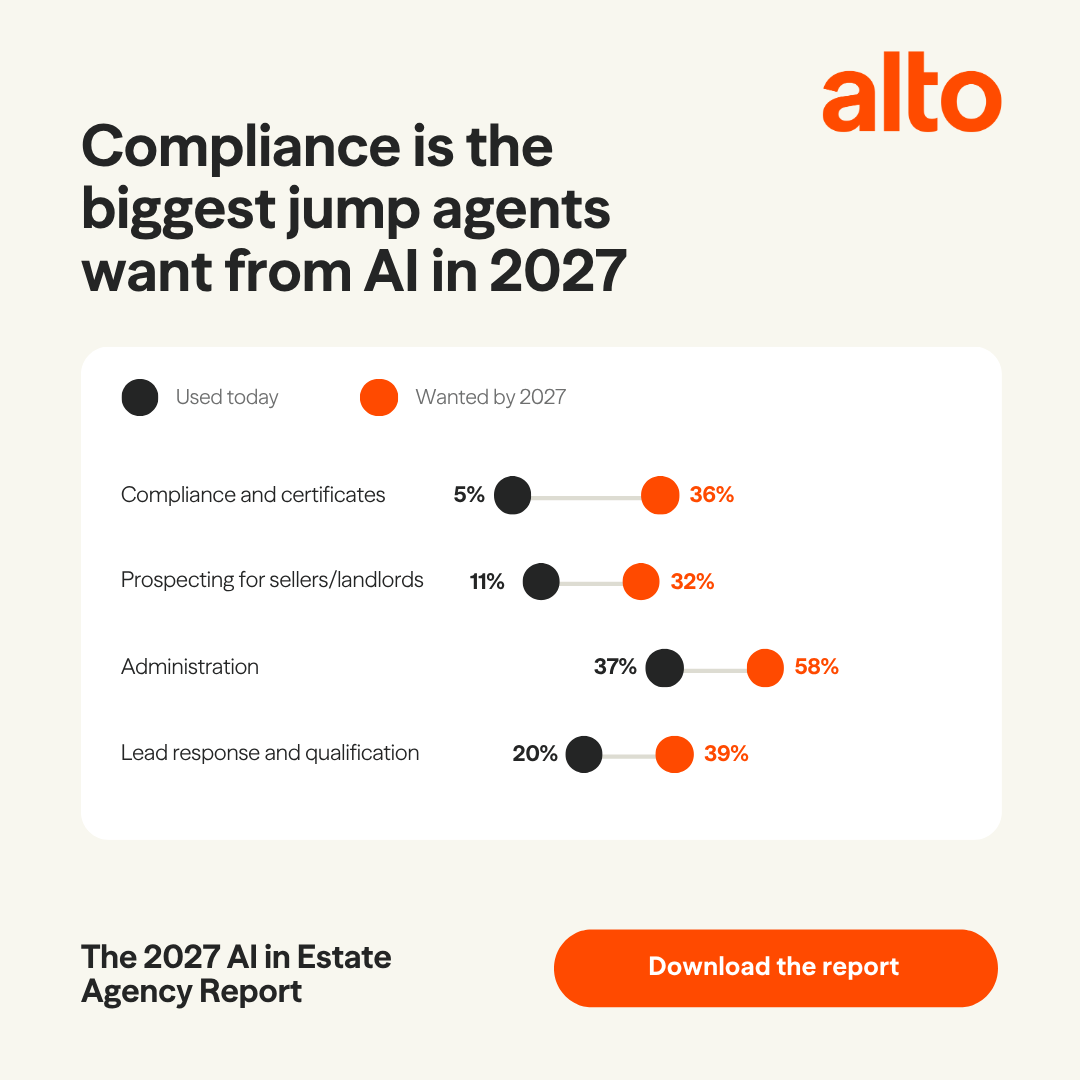
Dumbbell chart comparing current AI use by estate agents with their 2027 investment priorities: compliance rises from 5% to 36%, prospecting 11% to 32%, administration 37% to 58%, lead response 20% to 39%.
Compliance is the biggest gap in the survey. Two areas move the other way. Property descriptions are used by 67% but named as a priority by only 38%. Email drops from 53% to 32%. Those aren’t rejections. They’re jobs the sector considers solved, which is exactly what you’d expect where a free tool does a good enough job.
Every area with a positive gap is a process rather than a document, and none of them can be bought from a chatbot. Compliance automation needs the certificates and case data. Prospecting needs the database. Lead response needs the portal feed and the diary. This demand can only be met inside the systems agencies already run.
Ask about specific tools and the picture sharpens further. Top of the wishlist, at 44%, is AI that spots potential sellers and landlords before competitors do. Instant lead response and viewing booking, and automated AML and identity verification, tie at 38%. Instant performance reporting sits at 34%, and listings live in minutes at 32%.
Size changes the order. Single-branch agencies care most about lead response (46%, against 22% of two-to-five branch firms), because there’s nobody to cover the phones during a viewing. Multi-branch agencies push reporting and prospecting up the list. Admin rises with every size band: 55%, 61%, 64%.
What agencies plan to spend
Half of estate agencies expect to spend more on AI tools in the next 12 months, and not one expects to spend less. 13% expect a significant increase, 37% a modest one, 20% no change. Zero respondents chose “decrease”. Whatever agents think of AI, nobody is planning to retreat from it.
The 30% who said “don’t know” are the group to watch. Only 14% of owners and directors picked that answer, against 48% of lettings and property managers. The people doing the work often have no idea what’s being bought on their behalf.
Whether agencies spend more is settled. Whether the spend is deliberate is the open question. Half the sector increasing budgets while 46% of use is staff-led means a lot of that money will go on personal subscriptions in ones and twos, invisible to whoever manages the budget and impossible to consolidate later.
What this means for 2027
The adoption question has stopped being interesting. The ownership question has replaced it. 69% of agencies use AI, so knowing whether yours does tells you almost nothing about how it’ll perform. Knowing whether anybody owns it tells you nearly everything.
Three things follow. First, the gap is already measurable, and it’s compounding. The tools improve every quarter, and the agencies who’ve committed take every improvement as it arrives. By the time this shows up in fee income, it’ll be two years old.
Second, the demand has moved but supply hasn’t followed it. Agents want AI on compliance, prospecting, lead response and progression. Those jobs need the agency’s data, and the agency’s data lives in its CRM. That makes the choice of estate agency software the most important AI decision most agencies will make, because the CRM already holds the records, history and context AI needs to take on real work. We’ve written separately about what AI for estate agents can actually do in 2027, and the short version is that the useful stage is the one that finishes the job, not the one that drafts it.
Third, the 76% who worry about losing the personal touch are right, and that concern should be the design brief rather than the obstacle. The agencies getting real returns aren’t the ones that ignored it. They’ve put AI behind the client rather than in front of them: on preparation, reporting, compliance, admin and chasing. The agent still decides what gets sent.
That’s the thinking behind Alto Intelligence. Its skills take on whole jobs using the data already held in Alto, then hand the finished work back for approval. Appraisal Builder pulls the comparables and drafts the valuation context. Listing Writer produces descriptions in your agency’s voice, learned from the ones you’ve already written. Property Matcher finds the applicants most likely to buy or let, rather than just view. Progression Chaser works out which sales are stalling and drafts the chase. Message Writer drafts client communications in your house style. Alto IQ answers a plain-English question about your own business. Nothing reaches a client and nothing changes on a record until one of your people says so, and you can adjust the criteria each skill works to.
Each of those maps onto the wishlist above, and there’s nothing to learn: no prompting, no training course, no one technical to hire. The skills run inside the estate agent CRM and letting agent software your team already uses, on your own records. For the specific jobs highest on the 2027 list, Alto already has dedicated tools: Alto Prospecting for spotting sellers and landlords in your database (agents using it win an extra 2 to 3 instructions a month) and AutoCert for certificate renewals and compliance.
But the research is clear that the route into the top band doesn’t start with buying anything. It starts with naming one process, one owner and one number. Pick the job that eats the most time in your agency. Put someone’s name against it. Measure what it costs you now. Then find out what your software can already do about it, because there’s a better than even chance you’re paying for the answer already.
Get the full report
Alto’s AI in Estate Agency 2027 report covers everything above in detail, plus the findings this article didn’t have room for: the full breakdown by agency size, sales versus lettings, and by role, the sector’s hopes and fears, and a benchmarking section so you can see where your agency sits against the market.
Download the AI in Estate Agency 2027 report
Not sure where you stand? Test your agency’s AI maturity in seven questions, and see what Alto Intelligence can take off your plate.
Frequently asked questions
How many estate agents use AI in 2026?
69% of UK estate agents use AI regularly or daily, according to Alto’s AI in Estate Agency 2027 report. A further 18% have experimented but nothing stuck, and 13% aren’t using it at all. The survey covered 250 professionals from 86 agencies in July and August 2026.
What do estate agents use AI for?
Estate agents mainly use AI for writing: property descriptions (67%), emails (53%), admin (37%) and marketing and social media (35%). Use falls sharply for operational work, with only 11% using AI for prospecting, 5% for compliance and 4% for sales or lettings progression.
How much time does AI save estate agents?
AI saves the average estate agent 2.1 hours a week, or roughly 97 hours a year. The spread is wide: 41% save an hour or less, while agents using AI in two or more operational areas save 3.8 hours a week against 1.3 hours for those using it only for writing tasks.
What do estate agents want AI to do in 2027?
Estate agents want AI to take on admin (58%), lead response and qualification (39%), compliance and certificates (36%) and prospecting (32%). Compliance shows the biggest gap between current use (5%) and 2027 priority (36%). The single most wanted tool is AI that spots potential sellers and landlords before competitors, chosen by 44%.
Which estate agencies are getting the most from AI?
The most advanced fifth of agencies account for 48% of all time saved by AI in Alto’s research, and half of them are single-branch firms. What sets them apart is ownership: 60% describe AI adoption as a leadership decision, compared with 24% of the bottom half of the sample.
Will AI replace estate agents?
Most estate agents don’t think so. 65% believe AI will help but won’t change the fundamentals of agency, and only 5% see it as a threat to the traditional model. The biggest concern, held by 76% of agents, is losing the personal touch with clients, which is why the agencies getting the best results use AI for preparation and admin rather than client-facing decisions.
What is Alto Intelligence?
Alto Intelligence is the AI built into Alto’s estate agent CRM. Its skills, including Appraisal Builder, Listing Writer, Property Matcher, Progression Chaser, Message Writer and Alto IQ, complete whole jobs using the agency’s own data and hand the finished work back to an agent for approval before anything is sent or changed.
Do estate agents plan to spend more on AI?
Yes. 50% of estate agencies expect their AI spend to increase in the next 12 months, and none expect it to fall. 20% expect no change and 30% don’t know, with that uncertainty highest among lettings and property managers (48%) and lowest among owners and directors (14%).