

Picture two agencies with eight branches each.
Agency A finds out about a lapsed HMRC registration when a landlord asks to see it. Agency B finds out because a dashboard flagged it three weeks earlier, automatically, before anyone had to go looking.
Same size. Same regulations. Wildly different outcomes.
That gap is what separates the multi branch agencies that are thriving in 2026 from the ones quietly accumulating risk across their branch network. Compliance isn’t a new problem for UK agencies, but 2026 has made it a much bigger one. The Renters’ Rights Act has rewritten how tenancies, rent and possession work. HMRC is fining more agents than any other regulated sector for anti-money laundering (AML) failures. And every one of these obligations now has to be applied consistently, branch after branch, by different teams, on different days, without a single gap.
This article sets out what good actually looks like: the specific structures, habits and tools that the best-run multi branch agencies in the UK are using right now to stay compliant without drowning their teams in admin.
Why compliance hits multi branch agencies harder than anyone else
A single branch agency has one office, one team and one set of habits to get right. A multi branch agency has to get the same thing right five, ten, or fifty times over, with different branch managers, different tenures of staff, and often different legacy systems bolted together over the years.
Propertymark has flagged this directly, noting the added complexity faced by multi-disciplinary property businesses that run both sales and lettings under one roof, where AML and sanctions obligations don’t always map cleanly onto real-world, fast-moving transactions. That complexity multiplies with every additional branch.
The result is what we’d call branch drift: the gap that opens up between how Branch 1 (your best-run office, usually where the founder started) handles compliance, and how Branch 7 handles it, three regions away, run by a manager who joined last year and inherited a spreadsheet nobody’s updated since.
Branch drift is rarely intentional. It’s what happens by default when compliance depends on individual memory and manual process rather than a shared system. And it’s exactly what regulators, ombudsmen and Trading Standards find when they come looking.
The 2026 compliance load, in numbers
Multi branch leaders don’t need convincing that compliance matters. What’s useful is seeing the actual scale of what’s changed this year.
- 57% of all HMRC AML penalties between January 2024 and March 2025 were issued to estate and letting agents, more than any other regulated sector, including accountants and solicitors.
- £3.2 million in AML fines were issued across all regulated sectors in a single six-month period (October 2024 to March 2025), with 194 estate agencies fined a combined £1.09 million.
- £6,200 is the average AML fine per agency, with individual penalties ranging from £1,250 to more than £50,000. Read the full breakdown in our piece on what AML failures actually cost estate agents.
- £30,000 is the maximum civil penalty for a letting agent that fails to belong to a Client Money Protection scheme, with a further £5,000 fine possible for failing to display a valid certificate.
- 1 May 2026 marked Phase 1 of the Renters’ Rights Act: the end of fixed-term Assured Shorthold Tenancies and Section 21, replaced by Assured Periodic Tenancies and a Section 8-only possession process built on evidence.
- £40,000 is the maximum fine local authorities can now issue for serious or repeated Renters’ Rights Act breaches, alongside new criminal offences for misusing possession grounds or submitting false information.
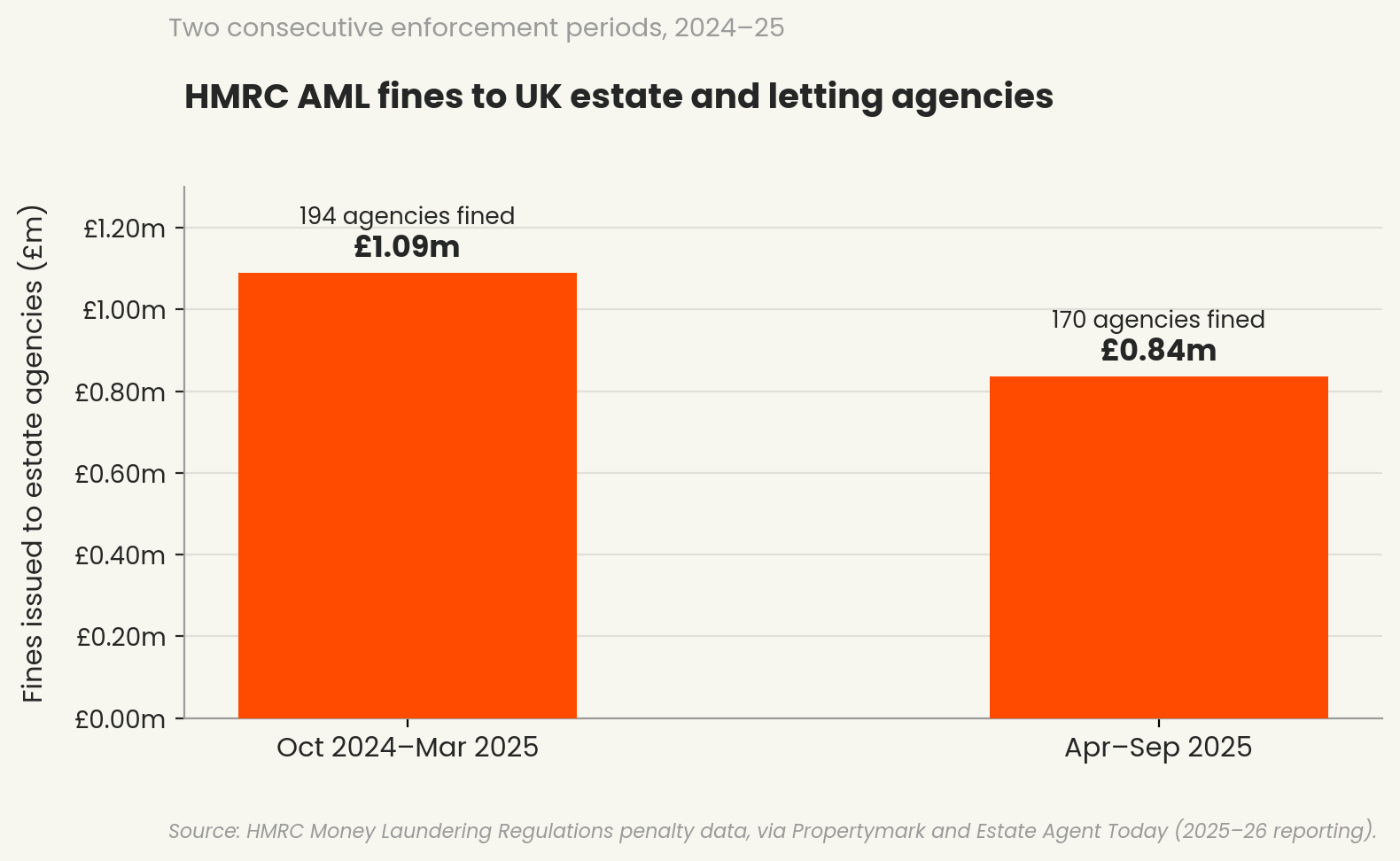
Two consecutive HMRC enforcement periods show the sector is being fined at a sustained rate, not a one-off spike. (Source: HMRC Money Laundering Regulations penalty data, via Propertymark and Estate Agent Today, 2025–26 reporting.)
None of these numbers are abstract for a multi branch agency. They scale with your branch count. A registration lapse, a missed sanctions check or an out-of-date tenancy template doesn’t just create risk in one office. It creates the same risk everywhere that process is used, which for a growing group can mean dozens of exposures from a single oversight.
For the detail on how the Renters’ Rights Act actually changes day-to-day letting operations, our legal lowdown from Mishcon de Reya walks through the new rent rules, possession grounds and phased rollout in full.
What good looks like: the six things top multi branch agencies get right
We looked across Alto’s own customer base, sector data from Propertymark and HMRC, and the compliance patterns that consistently separate agencies that pass inspection from those that don’t. Six things show up again and again.
1. One source of truth, not a branch-by-branch patchwork
The single biggest predictor of compliance failure at scale is fragmentation: one system for the CRM, another for ID checks, a shared drive for document templates, and a spreadsheet somewhere for tracking certificate expiry dates. Every one of those handoffs is a place where a gap can open up, and every branch that does it slightly differently multiplies the risk.
The agencies getting this right run every branch through a single CRM, with one client accounting ledger, one set of tenancy templates and one audit trail, regardless of how many offices are attached to it. That’s the whole premise behind Alto’s multi branch solution: real-time oversight of every branch from one dashboard, so a director in head office can see exactly what’s overdue, at risk, or coming up, without having to phone around.
2. AML and ID checks are built in, not bolted on
Given that estate and letting agents account for the majority of HMRC’s AML enforcement action, this is the area where “good” and “exposed” diverge fastest. Manual AML checks, chasing ID documents by email, storing them in different folders per branch, took UK agencies an average of 6 to 8 hours a week in admin according to Credas research, and left 64% of agents still relying on manual document checks even where digital tools were available.
Alto’s built-in AML and ID verification, powered by Thirdfort, is a good example: checks run inside our property management CRM with no separate login, no re-keying, and a fully auditable result attached to the client or property automatically. We’ve covered the full financial case for this in our AML cost breakdown.
3. Client accounting that’s audit-ready by default
With an estimated £2.7 billion held in client accounts across the UK lettings sector at any one time, according to Propertymark, client money is the single area regulators, Trading Standards and CMP schemes scrutinise hardest. For a multi branch agency, that means every branch’s ledger, reconciliation and rent cycle needs to hold up to the same standard, whether it’s your flagship office or the one that opened six months ago.
The agencies that pass CMP inspections without drama tend to have automated client accounting built into the same platform as their lettings management, so reconciliations, statements and audit trails are generated consistently across every branch rather than reconstructed manually when an inspector calls.
4. Evidence, not memory
The Renters’ Rights Act has changed what “compliant” actually means in practice. As our legal lowdown with Mishcon de Reya sets out, possession cases now depend entirely on what an agent can evidence: what was sent, when, to whom, and what happened next. Rent increases, information sheets, complaints and incidents all need a timestamped record that stands up if a tenant challenges it at the First-tier Tribunal, or if a case ends up in court.
That’s a much harder standard to hit across ten branches than one. The best multi branch agencies build this in structurally, so every message, document and compliance date is captured automatically as part of the workflow rather than relying on individual staff to remember to log it. Our webinar recap on how Alto keeps agents ahead of Renters’ Rights compliance shows what this looks like in practice, including bulk conversion of tenancies to the new Assured Periodic Tenancy structure and automatic blocks on non-compliant terms.
5. Real-time visibility across every branch, not monthly surprises
Directors running multi branch agencies can’t be in every office, every day. The ones managing compliance well don’t try to be. Instead, they rely on dashboards that surface what’s overdue, at risk or coming up across the entire branch network in real time, whether that’s an EPC due to expire, a certificate lapsing, or a rent review deadline approaching.
This is precisely the gap Alto’s customisable reporting and analytics is built to close for growing groups, giving branch-level and portfolio-level visibility from a single screen. Chase Buchanan, an eight-branch agency, saved 60 hours a week after consolidating onto one system, time that would otherwise have gone into exactly this kind of manual chasing.
6. Consistent training, consistent documents, consistent standards
Propertymark’s own guidance on the Renters’ Rights transition is blunt about this: staff training cannot be an afterthought, and poor practice at branch level risks reputational damage and enforcement action, even when senior leadership fully understands the rules. A director who’s read every regulation cover to cover is no protection if a negotiator in branch six is still using a tenancy template from 2023.
The agencies getting this right centralise their document templates and legal wording in one place, so every branch is issuing the same, current, compliant version of every document, and it updates everywhere the moment legislation changes. That’s the thinking behind Alto’s Lettings Centre, which keeps agreement templates current automatically rather than leaving branch managers to track legislative changes themselves.
7. Certificate renewals that run themselves, not get chased manually
The best multi branch agencies are moving certificate compliance from something a person has to remember and chase, to something a system runs automatically, only escalating to a property manager when a genuine decision is needed.
Gas safety is the clearest example of why this matters at scale. It’s a legal requirement on every rented property with gas appliances, renewable every 12 months under the Gas Safety (Installation and Use) Regulations 1998, and getting it wrong is a criminal offence carrying an unlimited fine. Since the Renters’ Rights Act came into force, councils have a duty, not just a discretion, to enforce it, with civil penalties of up to £7,000 for a minor breach and up to £40,000 for a serious or repeat one. From December 2025, councils also gained powers to demand 12 months of compliance documents on request.
Manually coordinating a single renewal means notifying landlords and tenants, instructing a supplier, chasing the inspection, processing the invoice, validating the certificate against nine legal checks, distributing it, and updating the record, all before the expiry date. Across a portfolio of hundreds of properties, that’s not a task a property manager does once. It’s a task they do continuously, forever, alongside everything else on their desk, which is exactly the kind of process where branch drift takes hold: Branch 1 stays on top of it because that’s where the strongest operator sits, and Branch 7 doesn’t, because nobody built a system that makes it automatic.
This is the gap AutoCert is built to close. Powered by Aguru and running natively inside Alto, AutoCert monitors every property in a portfolio, triggers the renewal workflow automatically as a certificate approaches expiry, and handles the full chain itself: supplier instruction, chasing, invoice processing, legal validation against all nine statutory checks, and distribution to landlord and tenant.
A property manager only gets pulled in when something needs an actual decision, not to run the process.
Early results show it cutting admin time per gas safety renewal by 80%, which scales to roughly 70 hours saved per branch per year across a typical managed portfolio. This is what modern property management software looks like.
“AutoCert has already delivered more value than we ever expected. It literally saves us hours on renewals, gives us peace of mind during peak periods, and allows us to grow without increasing headcount.” – Sam Whitehead, Operations Manager, The Accommodation Bureau
For a multi branch agency, the value compounds with every additional office: one automated workflow, running the same way in every branch, closes exactly the kind of inconsistency that turns a single missed renewal into a group-wide exposure. Gas safety is live now. EICR, EPC and PAT renewals are next on the roadmap, extending the same model to the rest of the certificate burden that currently depends on individual memory. Read the full breakdown in AutoCert launches: how AI is automating gas safety certificates for letting agents.
What good looks like vs what falls short
| Area | What falls short | What good looks like |
|---|---|---|
| Systems | Separate CRM, ID checks, document storage and spreadsheets per branch | One CRM, one client ledger, one audit trail across every branch |
| AML & sanctions | Manual ID checks, chased by email, filed inconsistently | Built-in ID and AML verification logged automatically against every client |
| Client money | Reconciliations reconstructed manually before inspections | Automated client accounting, audit-ready by default, every branch |
| Renters’ Rights evidence | “We’re pretty sure it was sent” | Timestamped, searchable records of every document, message and deadline |
| Certificate renewals | Property managers manually chasing suppliers, invoices and certificates per branch | An AI agent (AutoCert) that runs the renewal end-to-end and only escalates exceptions |
| Oversight | Director finds out branch is behind at month-end, or later | Real-time dashboards flag risk across all branches as it happens |
| Documents & training | Templates vary by branch, legislation updates handled ad hoc | Centralised, auto-updating templates and consistent staff training |
A short compliance self-audit for multi branch leaders
If you run more than one branch, these are worth answering honestly today, not after an inspection:
- Could you pull HMRC AML registration status, CDD records, and sanctions screening logs for every branch within minutes, not days?
- Is your Client Money Protection certificate current and correctly displayed at every branch and on every relevant page of your website?
- Have all your tenancy agreements been updated to reflect the Renters’ Rights Act’s Written Statement of Terms requirements as of 1 May 2026?
- If a tenant challenged a rent increase or possession case tomorrow, could you produce a full, timestamped evidence trail for that tenancy without piecing it together from memory?
- Do all your branches use the same tenancy and compliance document templates, or has drift crept in over time?
- When did every branch last receive AML and Renters’ Rights training, and could you prove it?
If any of those made you pause, that’s the starting point, not a reason to panic. It’s exactly the gap that a single, connected system is designed to close.
The bigger picture: compliance as a growth enabler, not a brake
It’s tempting to think of compliance purely as risk management: the thing you do to avoid fines. For the best multi branch agencies, it’s become something closer to a competitive advantage. Landlords increasingly ask harder questions before instructing a multi branch group, and a clean, demonstrable compliance record, backed by real audit trails rather than reassurances, is now part of how larger agencies win and retain business.
Getting compliance right at scale isn’t about adding more checklists or more admin per branch. It’s about removing the places where inconsistency can creep in, so every branch operates to the same standard without needing constant oversight from head office. That’s what separates agencies quietly managing risk in the background from agencies firefighting it in public.
If you want to see how Alto brings AML checks, client accounting, EPC tracking, audit trails and branch-level reporting into one system for growing agencies, take a look at our multi branch solution or book a demo to see it against your own branch network.
Frequently asked questions
What is the biggest compliance risk for multi branch estate and letting agencies in 2026?
Inconsistency between branches, sometimes called branch drift, is the biggest risk. Estate and letting agents already account for 57% of all HMRC AML penalties, and the Renters’ Rights Act has added new evidence and record-keeping requirements. When branches handle these differently, one office’s compliance gap becomes a group-wide exposure.
How much does poor AML compliance cost UK estate and letting agencies?
HMRC fines for AML breaches range from £1,250 to over £50,000, averaging around £6,200 per agency. On top of fines, manual AML processes cost the average agency 6 to 8 hours of staff time per week, and small independent agencies spend roughly £16,000 a year on compliance activity, according to a 2025 Credas survey.
What changed for letting agents on 1 May 2026?
Phase 1 of the Renters’ Rights Act came into force on 1 May 2026, abolishing fixed-term Assured Shorthold Tenancies and Section 21 evictions. All tenancies converted to rolling Assured Periodic Tenancies, and possession must now go through Section 8, using one of 37 grounds set out in the Act, supported by clear evidence.
What is Client Money Protection and does it apply to multi branch agencies?
Client Money Protection (CMP) is a mandatory scheme, required since April 2019, that reimburses landlords and tenants if a letting agent misappropriates rent, deposits or other client funds. It applies to every branch handling client money, not just the head office, and failure to belong to a scheme carries a penalty of up to £30,000 per breach.
How can multi branch agencies keep compliance consistent across all their branches?
The most effective approach is consolidating onto a single CRM with built-in AML checks, automated client accounting, centralised document templates and real-time, branch-level reporting. This removes the manual handoffs where inconsistency and error creep in, so every branch works from the same system, the same templates and the same audit trail.
How can multi branch agencies automate gas safety certificate renewals?
AutoCert, an AI agent built by Aguru and integrated natively into Alto, automates the full gas safety renewal process: detecting upcoming expiry dates, instructing suppliers, processing invoices, validating certificates against all nine legal requirements, and updating records automatically. It reduces admin time per renewal by 80% and only involves a property manager when an exception needs a decision.
What happens if a letting agent misses a gas safety certificate renewal?
Missing a gas safety certificate renewal is a criminal offence under the Gas Safety (Installation and Use) Regulations 1998, carrying an unlimited fine. Under the Renters’ Rights Act, local councils now have a duty to enforce compliance and can issue civil penalties of up to £7,000 for a minor breach and up to £40,000 for a serious or repeat one, alongside potential criminal prosecution.
Sources: HMRC AML enforcement data via Estate Agent Today and Flex AML; Credas 2025 UK estate agent compliance survey; Propertymark Client Money Protection guidance and policy campaign records; Renters’ Rights Act legal briefing delivered by Mishcon de Reya for Alto Software.