
Alto Intelligence is live. Here’s what the shift from AI features to AI execution really means for your agency.
Estate agency AI software is changing fast. But most of what’s being marketed right now is incremental — faster listing descriptions, automated replies, small productivity gains bolted onto tools that were never designed to work together.
Those things are useful. They are not transformational.
What estate agency AI software should do is change where work happens, not just how quickly. That distinction matters more than any individual feature.
Why do most estate agencies still struggle with fragmented systems?
Today, most agencies operate across a fragmented set of tools and processes. Enquiries come in through one system, responses happen in another, chasing sits in someone’s inbox, and compliance lives somewhere else again.
The CRM is expected to tie it all together — but in reality, it is often the last place to know what has actually happened.
That creates a lack of visibility, a lack of consistency, and ultimately a lack of control. You cannot improve what you cannot see. And you cannot scale what you cannot rely on.
What is the difference between a CRM as a system of record and a system of execution?
A system of record is where work gets logged after it happens. A system of execution is where work actually happens — triggered automatically, captured in real time, measurable from the start.
When estate agency AI software operates inside the CRM itself — under the same rules, permissions and workflows that govern the business — every action is captured, every step is measurable, and every process can be improved over time.
This is not a feature change. It is a category shift.
How much time are estate agents losing to non-revenue tasks?
Most agents are not short on effort. Teams are busy, often stretched, working hard to keep pace with demand. The issue is where that effort is going.
A significant proportion of an agent’s time is consumed by tasks that do not directly generate revenue: chasing updates, managing enquiries, handling compliance, switching between platforms that don’t quite talk to each other.
The scale of the problem is well documented. Goodlord’s ‘Is Renting Broken?’ report, drawing on 2,650 responses from agents, landlords and tenants, found that 76% of letting agents say time spent on admin is limiting their ability to grow — with one in five calling it their single biggest operational challenge.
Based on Alto’s analysis of agency workflows, agents are losing around eight hours a week to tasks that could already be automated — the equivalent of ten full working weeks a year. In many agencies, a third to half of a negotiator’s week is non-revenue work.
That is not a marginal inefficiency. It is a structural constraint on growth. And it is the reason so many agencies feel busy without feeling in control.
Introducing Alto Intelligence
This is the problem Alto Intelligence is built to solve.
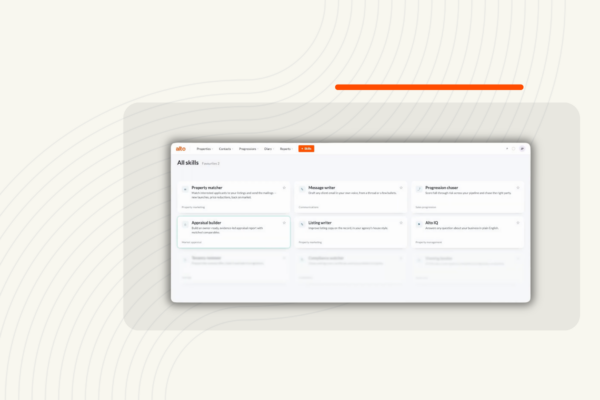
Alto Intelligence is not another layer of reporting. It is not a set of features added onto an existing system. It is a shift in how the platform operates — an intelligence layer that sits across your CRM, working through the same workflows your team already uses, removing the friction that slows everything down.
The right opportunities surface earlier. Work becomes lighter. And importantly, work keeps moving even when people are busy. Follow-ups happen. Processes progress. Compliance stays on track. All consistently — and without anyone having to remember to make it happen.
Find out more about Alto Intelligence →
For example, prospecting is no longer about building lists and hoping for the best. It becomes about acting on real signals in the market, earlier in the cycle. Alto Prospecting identifies who’s most likely to move and helps agents act on it. Agencies using it are winning two to three extra instructions per month on average, based on Alto customer data.
Lead handling no longer depends on someone being available at the right moment. Every enquiry is picked up, qualified and moved forward, even outside working hours. Listing creation shifts from a task that takes hours to something that happens in minutes, while the opportunity is still live.
Compliance moves from something reactive and easy to miss, to something that runs in the background, reducing risk before it builds up. With regulatory pressure increasing — particularly following the Renters’ Rights Act Phase 1 enforcement — consistency in compliance process is no longer optional.
And Alto IQ, our autonomous AI business analyst, mines your data in the background and surfaces the insights your team wouldn’t have had time to find.
More capability is coming across the year. But the philosophy doesn’t change: AI that works inside Alto, under your rules, handling the work that shouldn’t need a person — so the people you have can focus on the work that does.
What does AI execution look like in practice?
Consider a simple example: chasing a solicitor.
Traditionally, this relies on an individual remembering to follow up, sending an email, and optionally recording the interaction afterwards. There is little consistency, limited visibility, and no reliable way to measure performance.
When that same process runs inside Alto, the follow-up is triggered automatically, responses are captured in real time, escalation happens where needed, and the entire interaction is measurable.
That measurement matters. It allows agencies to understand how long processes take, where delays occur, and how performance improves over time.
Extend that across enquiry handling, listing creation, compliance and reporting — and the cumulative impact becomes significant.
Why is this shift happening now?
Stock is harder to secure. Competition is intensifying. Consumer expectations are rising, shaped in part by more structured, service-led models like Build-to-Rent. Regulatory complexity continues to increase — a theme we explored in depth in our analysis of where new build supply is really coming from.
In that environment, volume alone is no longer enough. Speed of response, consistency of execution, clarity of process — these have a direct impact on outcomes. Agencies that deliver these reliably will outperform those that rely on individual effort and fragmented systems.
The next few years will reward the agencies that operate the smartest. Not the ones that work the hardest.
What comes next
This is not about incremental improvement. It is about redefining how estate agency operates.
A model where repetitive work is handled automatically, and agents focus on decisions and relationships. Where every process is visible and measurable, and the business moves forward without constant manual intervention.
More deals, less admin, and more headspace for the work that actually drives growth.
That is the direction of travel. And that is what estate agency AI software looks like when it actually works.
Explore Alto Intelligence →
Frequently asked questions
What is estate agency AI software? Estate agency AI software automates the operational work that slows agencies down — chasing, qualifying, compliance tracking, listing creation — inside the tools agents already use. Unlike standalone AI tools, the best implementations work within your CRM, so every action is captured and measurable from the start.
What is Alto Intelligence? Alto Intelligence is the AI layer inside Alto CRM. It shifts the platform from a system of record to a system of execution — handling repetitive operational work inside the same workflows your team already uses. No new system to learn. The same platform, working harder.
What Alto Intelligence features are available now? Alto Prospecting and Alto Smart Listings are live now. Alto IQ — our autonomous AI business analyst — launches in May. Visit altosoftware.co.uk/alto-intelligence/ for the latest.
Does estate agency AI software replace estate agents? No. AI handles the process layer — chasing, logging, qualifying and compliance tracking. Agents focus on the relationship layer: conversations, valuations, negotiations and decisions that need local knowledge and genuine judgement. The goal is to redirect skilled people from admin to the work that actually wins business.
What does “CRM as a system of execution” mean? It means your CRM stops being a place where work is recorded after the fact, and starts being the place where work actually happens. Follow-ups are triggered automatically. Compliance stays on track in the background. Opportunities surface before your team goes looking. The business moves forward without constant manual intervention.
How much time can estate agency AI software save? Based on Alto’s analysis of agency workflows, agents lose around eight hours a week to tasks that could be automated — the equivalent of ten full working weeks a year. Goodlord’s 2026 research found 76% of letting agents say admin is actively limiting their growth. Alto Prospecting customers are winning two to three extra instructions per month on average, based on Alto customer data.